
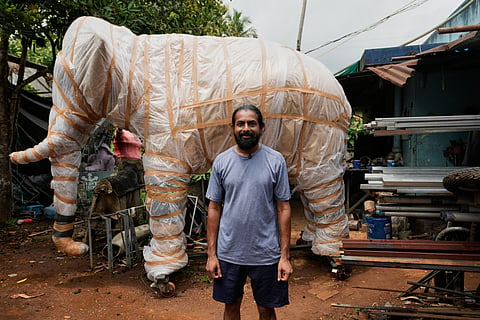
Robotic elephants draw crowds and controversy in some of India's Hindu temples
The life-sized robotic elephants in Prasanth Prakashan's backyard workshop can flap their ears, swish their tails and squirt water through their trunks.
That, however, is where the resemblance to their real-life counterparts largely ends.
Made from fibreglass, iron and rubber, the animatronic elephants are designed to replace live elephants in Hindu temples, where the animals have long been revered as sacred and are central to religious rituals and festivals.
The innovation has won praise from animal welfare groups, which see it as a humane alternative to keeping elephants in captivity. But it has also sparked opposition from traditionalists, who insist that live elephants are inseparable from temple ceremonies.
Animal rights organisation PETA India and several other non-profit groups have so far donated around 40 robotic elephants, each costing about US$6,000, to temples across India.
Although considerably lighter than a real elephant and lacking its graceful movements, the robots feature moving heads, blinking eyes and flexible body parts designed to replicate the appearance of the majestic animals.
Prakashan, a mechanical engineering graduate, readily acknowledges that his creations cannot fully replicate a living elephant.
"You can't create an original elephant, just as you cannot duplicate a human," he said. "But we try to capture the majestic animal's essence as much as we can."
One thing the robotic elephants cannot yet do is walk.
"But they will," Prakashan said with a smile. "I'm working on it."

A symbol of divinity
Elephants hold deep religious significance across South Asia.
In Hinduism, they are closely associated with Lord Ganesha, the elephant-headed deity of wisdom and prosperity. Buddhists also regard elephants as symbols of patience, wisdom and enlightenment.
In Sri Lanka's hill city of Kandy, elaborately decorated elephants participate in the annual Esala Perahera procession, with the largest traditionally carrying the Buddha's sacred tooth relic in a golden casket.
In Kerala, temple festivals featuring live elephants remain among the state's biggest attractions.
The annual Thrissur Pooram festival at Vadakkunnathan Temple includes around 100 elephants adorned with ornate golden headgear and colourful silk caparisons, while handlers fan them with peacock feathers and yak-tail whisks.
About 65 kilometres away, the Guruvayur Sree Krishna Temple houses nearly 50 elephants. The temple also stages an annual elephant race and conducts ceremonial feeding rituals in which the animals are offered rice, ghee, jaggery, fruit and vegetables following prayers.
Elephant processions also feature in festivals at St George Orthodox Syrian Church in Kunnamkulam and Pattambi Mosque in Kerala's Palakkad district.
Some temple elephants have achieved celebrity status.
Thechikkottukavu Ramachandran has nearly 150,000 followers on Facebook, while Guruvayur Keshavan—widely regarded as Kerala's most celebrated temple elephant—was honoured with a life-sized statue after his death in 1976. His life has also been chronicled in films and television programmes.
Andrea Gutierrez, a professor at the University of Texas who has researched captive elephants in South Asia, said Kerala's temple elephants are almost exclusively males, creating additional risks.
Adult bulls periodically enter musth, a condition that dramatically increases testosterone levels—sometimes by as much as 60 times normal—and makes them significantly more aggressive.
"But people want these huge, impressive tusks, which almost feels like a military presence," Gutierrez said.
Although regulations governing captive elephants have become stricter, Kerala is still home to nearly 400 captive elephants, out of around 2,500 across India. The number has fallen by about half since 2010.
A humane alternative
Khushboo Gupta, Vice-President of Policy at PETA India, argued that the visual appeal of live elephants cannot justify the suffering many endure in captivity.
"They are shackled, beaten and separated from their families," she said.
She also warned that stressed elephants can become dangerous. In 2024 alone, elephant-related incidents at temple festivals in Kerala claimed nine lives.
"These elephants are forced to stand for hours in the heat amid huge crowds, loud drums and fireworks," Gupta said. "Any trigger could cause them to go on a rampage."
Prakashan, who previously specialised in animatronics for shopping centres, amusement parks and carnivals, first came to PETA India's attention in 2023 after a video of his robotic elephants at a festival in Dubai went viral.
The organisation subsequently approached him, along with Kochi-based sculptor Sooraj Nambiat, to develop robotic elephants specifically for temples.
Demand quickly followed.
Prakashan initially used rubber exteriors but later switched to more durable fibreglass moulds. Artists meticulously recreate details ranging from wrinkled skin to the prominent veins visible on an elephant's ears.
Today, it takes his team around 15 days to complete each elephant.
"It was something we had to figure out on our own," he said.
Winning support among smaller temples
The first robotic elephant, named Irinjadapilly Raman, was delivered to Irinjadapilly Sree Krishna Temple in 2023.
During a recent visit, children were seen laughing as they hugged the robot's trunk—something that would be impossible with a live elephant.
Temple head priest Rajkumar Namboothiri said traditional Hindu scriptures governing temple rituals do not require the presence of live elephants.
He believes the practice developed centuries ago when elephants formed part of royal armies and palace life.
"They had forests and open spaces then," he said. "Now we have concrete jungles, heat and noise. Elephants are tortured and abused. It isn't right."
He added that portable palanquins and ceremonial chariots could perform the same ritual functions without relying on captive animals.
Temple devotee P.C. Subhash said live elephants remain important at larger temples but believed robotic elephants offer a practical and affordable alternative for smaller institutions, given the high costs of keeping live animals, including liability insurance.
"I really hope more people come to accept them," he said.
K.I. Purushottaman, president of Cheekamundi Sri Mahavishnu Temple in Thrissur, said the temple's robotic elephant had eased fears of a potentially fatal accident.
"With a robotic elephant, we don't have that fear," he said. "That's a big relief."
Tradition versus change
Despite growing acceptance in some quarters, resistance remains strong.
K. Mahesh, who rents out his elephant for temple festivals around 45 days each year, insists that live elephants are integral to religious tradition.
"If you don't believe elephants are sacred, what's the point of a robotic elephant in a temple?" he said.
Mahesh, who has owned his elephant for 25 years, described the animal as "like a family member or a pet" and said elephants bring joy to devotees when treated properly.
Several temple authorities have also rejected the use of robotic elephants during rituals and festivals.
Artist Sooraj Nambiat said the backlash has become so intense that he no longer attends temple festivals.
"This is my profession," he said. "I'm not trying to destroy tradition. But if we don't stop treating elephants as commodities, future generations may not have them at all."
Wildlife biologist and elephant expert P.S. Easa, who helped draft Kerala's captive elephant regulations, said enforcement remained challenging despite improvements.
"Sadly, there's a lot of money to be made from elephants," he said. "It's not about spirituality or even tradition. It's religious tourism."
Easa believes widespread acceptance of robotic elephants will take time.
"You cannot change centuries-old traditions overnight," he said. "But who knows? Maybe if these robotic elephants can start walking."