
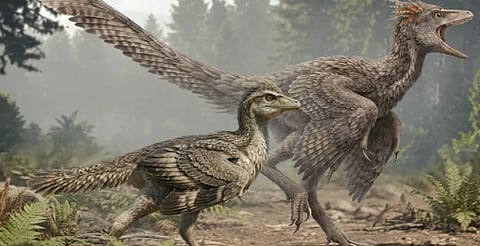
New Jurassic bird fossil offers fresh clues to how birds evolved shorter tails
Chinese researchers have discovered a new Jurassic bird fossil that is changing scientists' understanding of how birds evolved shorter tails, according to a study published online in the journal Science Advances on Thursday.
The fossil, named Zhengheornis buyu, was discovered by a joint research team from the Institute of Vertebrate Paleontology and Paleoanthropology under the Chinese Academy of Sciences and the Institute of Geological Sciences in east China's Fujian Province.
Researchers found that the bird had a short tail made up of only 15 shortened tail vertebrae but lacked a fused pygostyle, a bone found at the end of the tails of modern birds. By comparison, other long-tailed ancient birds had many more tail vertebrae.
The pygostyle is formed when several tail vertebrae fuse together. It is a key feature of modern birds, helping support feathers and playing an important role in flight. The shortening of the tail is considered one of the most significant physical changes that occurred as dinosaurs evolved into birds.
Scientists said the newly discovered bird weighed between 74 and 163 grams and measured about 20 centimetres in length, making it the smallest long-tailed bird fossil known so far.
Its unusual mix of features, a shortened tail without a fused pygostyle, makes the fossil especially important because it challenges the long-standing belief that no such transitional form existed during bird evolution.
Earlier fossil evidence suggested that the first birds with a pygostyle appeared during the Late Jurassic period around 150 million years ago, while other birds and their dinosaur ancestors still had long tails.
The researchers also said the discovery supports the idea that shrinking body size was a major factor in the evolution of birds from dinosaurs. Their findings suggest that some early birds became much smaller much faster than scientists had previously thought.