
Hemingway's century-old novel still fuels the rush to Pamplona's bulls
When Chicago writer and academic Bill Hillmann first picked up Ernest Hemingway's The Sun Also Rises as a teenager, he had little idea it would shape the course of his life.
He spent six uninterrupted hours reading the novel and, by the time he reached the final page, had made two decisions: he would become a writer, and he would one day run with the bulls in Pamplona.
More than two decades later, despite being gored three times and narrowly escaping death once, Hillmann remains devoted to Spain's famed San Fermín festival, which this year marks the 100th anniversary of the publication of Hemingway's landmark novel.
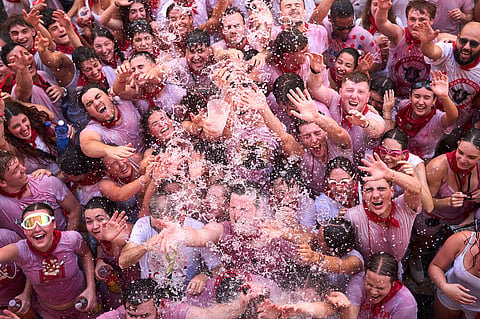
The annual festival officially began on Monday with the traditional chupinazo firework launched over a packed Plaza Consistorial, while the first of eight daily bull runs is scheduled for Tuesday.
For many visitors, particularly Americans, the festival remains inseparable from Hemingway's literary masterpiece, which introduced generations of readers to the thrill, danger and romance of Pamplona's streets.
Published in 1926, The Sun Also Rises propelled Hemingway to international fame with its portrayal of disillusioned American and British expatriates searching for meaning through travel, drink and impossible love during the Jazz Age.

The novel became a defining work of American literature, often mentioned alongside F. Scott Fitzgerald's The Great Gatsby, while helping popularise the phrase "Lost Generation" to describe expatriate writers living in Paris after the First World War.
Its vivid descriptions of the San Fermín festival transformed what had long been a local tradition into an international attraction.
"I sat there for about six hours, well past midnight, reading the book," Hillmann recalled while overlooking the enclosure where the bulls are kept before entering Pamplona's narrow cobbled streets.
"By the time I was done with that book, I was going to be a writer and I was going to be a bull runner."
Today, the 44-year-old has fulfilled both ambitions.
He has participated in hundreds of bull runs across Spain, earned a doctorate in English literature, teaches Hemingway's novel at East-West University in Chicago and has written extensively about the tradition.
His passion has endured despite the risks.
In 2014, Hillmann suffered severe injuries after another runner's mistake left him exposed to a charging bull. He lost a significant amount of blood and believed he might die. Three years later, he was gored again but insisted he would continue running.
"People think this is just crazy people running," he said after the 2017 incident. "There is real art. If you pay attention, you can see it."
Hillmann is far from alone. Americans remain the largest group of foreign participants in the San Fermín bull runs.
According to Pamplona City Hall, Americans accounted for 16 per cent of foreign runners in 2022—around four times as many as participants from neighbouring France.
Bruce Anderson, a Dallas-based tour operator whose company specialises in San Fermín trips, believes Hemingway deserves much of the credit.
This year alone, his firm has brought around 1,400 visitors to Pamplona, with more than two-thirds arriving from the United States.
"There’s a lot of energy, a lot of excitement around just remembering that book and the impact that it’s had," Anderson said.
A lifelong Hemingway admirer, Anderson often visits the historic Café Iruña, one of the author's favourite haunts and a location immortalised in The Sun Also Rises. Today, a life-sized statue of Hemingway stands inside the café, leaning against the bar.
With his thick white beard, Anderson himself frequently attracts attention from locals, who affectionately greet him as "Papa" — Hemingway's famous nickname.
The American writer's presence remains almost impossible to avoid throughout Pamplona.
Hotels, cafés and restaurants proudly advertise their connection to him. A statue stands outside the city's bullring, while banners celebrating the novel hang across public spaces.
One banner features Hemingway's famous description of the festival's opening day:
"At noon of Sunday, the 6th of July, the fiesta exploded. There is no other way to describe it."
The Hotel La Perla, where Hemingway stayed during several visits, still preserves the suite he occupied in the 1950s. Furnished much as it was during his lifetime, the room overlooks the bull-running route and contains shelves filled with editions of The Sun Also Rises.
"Hemingway did a lot for Pamplona because he made it known around the world," said Fernando Hualde, who spent four decades working at the hotel.
Yet Hemingway's legacy has become increasingly complex.
Critics have questioned both his famously masculine public image and his enthusiastic admiration for bullfighting, which occupies a significant portion of The Sun Also Rises.
Animal rights campaigners argue that celebrating the novel also celebrates practices they believe no longer belong in modern society.
"Hemingway wrote about many themes that today would not be accepted," said animal welfare activist Brook Spurling during a protest against the festival's bullfights.
"He writes about hunting, about war, and we don't want to be appreciating these themes today."
Others argue that Hemingway's global success has contributed to overtourism.
Pamplona's population of around 200,000 swells by more than one million visitors during the nine-day festival, approximately 15 per cent of whom come from overseas.
Many younger tourists, critics say, imitate not only Hemingway's fascination with the festival but also his heavy drinking.
Some residents have even begun celebrating places the writer never visited.
Gabriel Insausti, a literature professor at the University of Navarra, recalls visiting a local bar displaying a sign reading: "Hemingway was not here."
"In general, Hemingway has become a product of a franchise associated with the San Fermín festival that has obscured his novel," Insausti said.
"People know who Hemingway is, but they haven't read his novel."
For Hillmann, however, the power of Hemingway's writing continues to outweigh any criticism.
He believes today's greatest danger comes not from the bulls themselves but from inexperienced runners unfamiliar with the traditions.
Although no participant has died during the bull runs since 2009, gorings and injuries remain common each year.
The festival also continues to resonate with Hemingway's family.
His granddaughter, actress Mariel Hemingway, who has spoken publicly about her grandfather's struggles with mental illness before his death in 1961, believes the enduring appeal of his work lies in its universal themes rather than the spectacle of the bull runs.
"Identity, love, purpose, and how to rebuild after profound loss... those themes haven't ever changed," she said.
"I think he captured something that will never go away."