
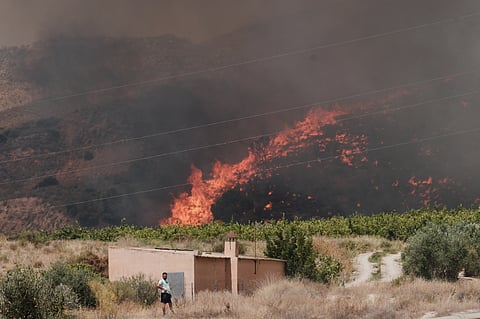
12 killed in one of Spain's deadliest wildfires; 23 missing
One of Spain's deadliest wildfires on record killed 12 people overnight into Friday, authorities said, as soaring temperatures continued to grip much of the country.
Several victims of the blaze in the southern province of Almeria, a popular holiday destination, were found inside burnt-out vehicles and are believed to have died while trying to flee the flames.
Eight people were injured and a further 23 remain unaccounted for, Andalusia's regional leader Juan Manuel Moreno said. Around 150 firefighters and 220 soldiers from Spain's Military Emergency Unit were battling the blaze, which has consumed more than 3,200 hectares (7,900 acres) of forest and farmland.
Regional emergency authorities said four British nationals and several other foreign nationals appeared to be among the dead.
Victims tried to flee on foot and by car
The fire broke out in a hamlet in a semi-arid area near the Sierra de Los Filabres mountains. Authorities have not confirmed the cause, but said callers who reported the fire indicated that a fallen power line had sparked a blaze which spread rapidly into a nearby forest.
Most of the victims died while attempting to flee after ignoring instructions to shelter in place, said Antonio Sanz, president of Andalusia's emergency services. One group attempted to escape via a dry riverbed, which "turned into a death trap", he said.
Seven people died on foot after abandoning their cars, Sanz said, apparently while searching for a way to escape.
"The consequences have been terrible. Everything seems to indicate that, in the case of the deceased ... we are dealing for the most part, if not entirely, with foreign nationals," Sanz said.
Spanish Prime Minister Pedro Sánchez expressed his condolences.
"Immense sadness and desolation in the face of the terrible consequences of the fire affecting the province of Almeria," he wrote on X.
Europe battles another heatwave
Spain has experienced frequent and severe heatwaves in recent years, with temperatures often exceeding 40C. Strong winds, extreme heat and a lack of rainfall have allowed small fires to develop into major wildfires.
In June, Spain recorded several days of record-breaking heat, with more than 1,000 excess deaths attributed to the high temperatures.
Europe is the world's fastest-warming continent, with temperatures rising twice as fast as the global average since the 1980s, according to the European Union's Copernicus Climate Change Service. Parts of Western Europe are experiencing their third heatwave in six weeks. Globally, 2025 was the third-hottest year on record, bringing several intense heatwaves across Europe.
France is experiencing the peak of its third heatwave of the summer, with temperatures reaching 40C across western and central regions and around 37C in Paris.
French authorities have also warned of a very high wildfire risk, as large fires in the south have already scorched thousands of hectares this week, disrupting the Tour de France and stretching firefighting resources.
The largest wildfire, which broke out in the eastern Pyrenees near the Spanish border, has eased in intensity, authorities said on Friday.
It burned around 5,000 hectares (12,000 acres) and forced the evacuation of more than 10,000 people from nearby villages, who have since been allowed to return home.
Last month was France's hottest June on record, with deaths rising by nearly a third during the hottest week.
Scientists warn that climate change, driven in part by the burning of fossil fuels such as petrol, oil and coal, is increasing the frequency and intensity of extreme heat and drought, making some regions more vulnerable to wildfires.
Spain and Portugal have faced deadly wildfires before
Spain is no stranger to wildfires. Last year's fire season burned more than 393,000 hectares (almost 1,520 square miles), according to the European Forest Fire Information System—an area roughly twice the size of London. Four people died.
In neighbouring Portugal, a wildfire in 2017 killed 66 people in Pedrógão Grande, about 200 kilometres (120 miles) north-east of Lisbon.
In that blaze, 47 people died on a single road while attempting to flee in their cars.