
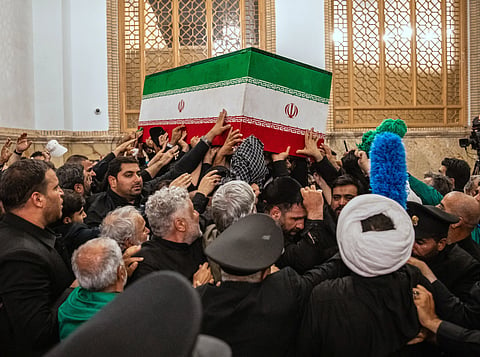
Trump warns Iran after anti-US chants at Khamenei funeral fuel regional tensions
US President Donald Trump on Saturday issued a fresh warning to Iran following funeral ceremonies for Supreme Leader Ayatollah Ali Khamenei, where mourners openly called for Trump's killing, heightening tensions in the Middle East despite an interim agreement aimed at preventing renewed conflict.
Trump made the remarks on his Truth Social platform after senior US officials urged Tehran to publicly guarantee safe passage for international shipping through the Strait of Hormuz, a critical global energy route.
Iran has so far refused to make such a commitment, maintaining that the strategic waterway should remain under its control and insisting that vessels transiting the strait should pay fees to Tehran, challenging the long-standing international position that the passage is an international waterway.
The latest exchange comes after days of military escalation that included US airstrikes on Iranian targets and retaliatory Iranian attacks across the region. The violence was triggered after Iran allegedly attacked three commercial vessels in the Strait of Hormuz earlier this week.
In his social media post, Trump warned that the United States was prepared to respond forcefully if Iran acted on what he described as threats against him.
He said hundreds of missiles were ready to strike Iran should the Iranian government attempt to carry out any threat to assassinate him.
During Khamenei's funeral, mourners carried banners and posters calling for the deaths of both Trump and Israeli Prime Minister Benjamin Netanyahu.
Khamenei, 86, was killed in an airstrike at the start of the Iran war on Feb. 28. His funeral took place this week after several days of ceremonies held in cities across Iran and Iraq.
Trump also declared that the US military would completely destroy targets across Iran if necessary, again invoking religious language in his statement.
Throughout the conflict and the subsequent ceasefire, Trump has repeatedly combined warnings against Iran with references to God in Arabic, drawing criticism from advocacy groups, including the Council on American-Islamic Relations (CAIR), over his rhetoric.