
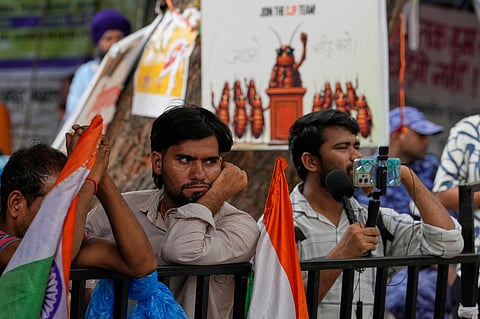
India's Gen Z 'cockroaches' took protest to the streets. Now they rally around a hunger strike
A youth-led protest movement in India has rallied around climate activist Sonam Wangchuk, whose ongoing hunger strike has become the focal point of a campaign demanding sweeping reforms to the country's examination system and the resignation of the education minister.
At a protest camp in New Delhi, student demonstrators continue to spend their days and nights at Jantar Mantar, while Wangchuk, 59, remains on hunger strike inside a tent after weeks without food.
"If not fasting, then what? Riots in the streets? That's what we don't want. This is a peaceful way to make the government hear our voice," Wangchuk said.
Wangchuk has emerged as the face of the Cockroach Janta Party, a youth-driven movement that began online two months ago and quickly gained nationwide attention over alleged social media leaks linked to India's highly competitive college entrance examinations.
With the hunger strike entering its third week, organisers say they are trying to maintain pressure on Prime Minister Narendra Modi's government, accusing it of ignoring their demand for the resignation of Education Minister Dharmendra Pradhan.
"There has been no response from the government. They have left Sonam Wangchuk to die," said Abhijeet Dipke, founder of the Cockroach Janta Party and a student at Boston University.
The movement began in May after Supreme Court Chief Justice Surya Kant referred to some unemployed young people as "cockroaches" during a court hearing on an unrelated matter. Supporters embraced the term as a symbol of resilience, turning it into a satirical political campaign that attracted more than 21 million Instagram followers within days.
Besides seeking the minister's resignation, protesters are calling for major reforms to the examination system and compensation for the families of students who died by suicide following alleged exam paper leaks or examination results.
For millions of young Indians, admission to medical colleges and recruitment to government jobs depend heavily on a single competitive examination.
Dipke said the movement has expanded well beyond social media. Since its first major rally in New Delhi in early June, thousands of supporters have taken part in demonstrations at universities and in several other cities.
The involvement of Wangchuk, who is widely known for his environmental activism, has also attracted professionals and public figures beyond the student community. Opposition politicians and several Bollywood personalities have visited the protest site or expressed support in recent days.
Despite its strong online following, attendance at the New Delhi protest has remained relatively modest. A few hundred people typically join the sit-in each day, with numbers rising to around 1,000 in the evenings. Many protesters have continued camping at the site despite heavy monsoon rain.
Unlike traditional political parties, the movement has no formal organisational structure. Supporters cover their own travel and living expenses while staying at Jantar Mantar, a designated protest site under police supervision. So far, police have not attempted to disperse the demonstrators.
Ajay Zingade, a 33-year-old IT professional, said repeated reports of exam paper leaks had prompted him to join the campaign.
"I am just exercising my fundamental right to dissent," he said.
Organisers say the campaign has evolved into a broader call for greater accountability and the restoration of public trust in institutions, including the education system, the judiciary, the political leadership and the media.
"The system needs a complete overhaul because it is no longer accountable or taking basic responsibility," Dipke said.
The government has neither responded publicly to the protesters' demands nor entered into talks with organisers. The Education Ministry did not respond to questions from the Associated Press.
Senior government leaders have largely dismissed the movement. Dharmendra Pradhan has accused its members of acting against the country's interests, while other officials have said there is no need for the government to negotiate with the protesters, despite acknowledging students' concerns.
Organisers say the government's silence has only strengthened their resolve as Wangchuk continues his fast.
"In a democracy, the government should listen to the people, engage in dialogue and remain accountable. I don't know why the government isn't doing that," Dipke said.
Wangchuk said his hunger strike was intended to promote peaceful protest rather than violence.
"It is about demanding accountability, which is essential for any government," he said.
Organisers are now preparing a march to Parliament on Monday to take their demands directly to lawmakers.
"We hope the government is wise enough to respond to peaceful methods instead of waiting for less peaceful ones," Wangchuk said.
Dipke said the protesters were prepared for a prolonged campaign.
"The government may have thought we were just young people who would eventually go home. But we have shown that we are prepared for a long struggle, and we are not leaving," he said.