
Republicans continue backing Iran war despite growing political risks
Republicans in the U.S. Congress are trying to balance support for the Iran war with the political risks of defending an increasingly unpopular conflict as elections approach and the future of the war remains uncertain.
The pressure has intensified in recent days, especially for Republican lawmakers seeking reelection in November. While some GOP members say they want more information from President Donald Trump's administration about the war's objectives and rising costs, they have continued to support the president's decision to engage militarily and have repeatedly voted to leave key war-making powers in the hands of the White House.
"Is anyone out there in the real world happy with gas prices? No," said Republican Sen. John Kennedy of Louisiana after questioning military leaders during a tense Senate hearing Tuesday. "But I think they understand why gas prices are as high as they are."
It remains unclear whether more Republicans who have privately expressed concerns about the conflict will begin speaking out publicly as the midterm elections get closer. Lawmakers in both the House and Senate are expected to face another major test of their support for Trump this week as Democrats push for new votes requiring congressional approval for military action against Iran.
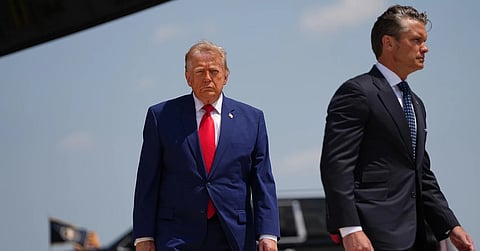
The debate comes as the United States has launched multiple rounds of airstrikes against Iran during the escalating confrontation over the Strait of Hormuz. Fuel prices have risen sharply, and Defense Secretary Pete Hegseth told senators Tuesday that the war has already cost the United States about $37.5 billion. On Wednesday, Trump traveled to Dover Air Force Base to receive the remains of four American service members killed during the conflict.
Maryland Democratic Sen. Chris Van Hollen, who is expected to lead the next Senate war powers vote as early as Thursday, said the combination of congressional hearings, American casualties and rising economic costs makes it important for officials to be held accountable.
"This is a very unpopular war," Van Hollen said.
Polls show public opposition
Recent polling suggests that most Americans disapprove of Trump's handling of the Iran conflict. A July survey by The Washington Post and Ipsos found that relatively few Americans believe the war has been worth fighting, and most are not confident that U.S. military action and negotiations will prevent Iran from developing nuclear weapons.
The poll also showed that only about two-thirds of Republicans approve of Trump's handling of Iran. While around 60% of Republicans believe the war has been worth fighting and are confident it will stop Iran from obtaining a nuclear weapon, roughly one-third remain unconvinced.
Republican Sen. Mike Rounds of South Dakota, who is seeking reelection, said he has tried to explain to voters that he has reviewed classified intelligence and believes military action was necessary to prevent Iran from acquiring a nuclear weapon.
"It's challenging," Rounds said. "It's complicated, and a lot of the stuff we know, we can't talk about, because it's classified."
Maine Republican Sen. Susan Collins, another lawmaker facing reelection, questioned military leaders Tuesday about the closure of the Strait of Hormuz.
"It seems to me that there's been a different plan almost daily with dealing with this problem," she told Hegseth and Joint Chiefs Chairman Gen. Dan Caine.
War powers votes become more contentious
Opposing the war has also carried political risks. Collins was one of four Republicans who joined Democrats in June when the Senate passed a war powers resolution on Iran for the first time. The vote angered Trump, who reportedly called the four Republicans "losers" during a GOP Senate luncheon the following day.
Another Republican who supported that resolution was Louisiana Sen. Bill Cassidy, who later lost his Senate seat in a primary after Trump endorsed a challenger.
During the closed-door luncheon, Cassidy reportedly told Trump that the administration needed to provide more details about the conflict.
"This was supposed to last four weeks, it's lasted four months," Cassidy said. "Our original objectives have not been achieved."
Cassidy later said Trump argued back, and he refused to change his position until he received a briefing. After the White House arranged a private meeting with him, Cassidy changed his vote during a late-night revote before the Senate left for a two-week recess.
On Wednesday, Cassidy declined to say whether the latest developments would affect his vote on the next effort to halt the war.
House to take up another resolution
The House of Representatives is expected to consider a similar war powers resolution on Thursday after approving one in June. It is unclear whether enough Republicans will again join Democrats to pass the measure, which is being led by Democratic Rep. Pramila Jayapal of Washington.
House Speaker Mike Johnson has strongly urged Republican members to oppose the resolutions. Echoing Trump's argument, Johnson said the U.S. has acted to ensure that Iran does not obtain a nuclear weapon, which he called a potential disaster.
At the same time, Johnson said there is broad agreement that "now we got to wrap it up."
Before leaving for Dover on Wednesday, Trump defended his handling of the war.
"Americans don't want high gasoline prices but they aren't against the war," he said.