
Hiroshima memoir reveals agony of Pastor’s search for family after atomic bomb
A newly unearthed memoir by Hiroshima survivor and Methodist pastor Kiyoshi Tanimoto has revealed a haunting first-hand account of the devastation wrought by the US atomic bombing of Hiroshima, documenting his desperate search for his wife and infant daughter amid flattened neighbourhoods, raging fires and thousands of wounded civilians.
According to an exclusive extract published by The Guardian, Tanimoto recalled that most residents neither saw the aircraft nor heard the explosion. Instead, many experienced only a blinding flash before collapsing unconscious, only to awaken burned, unclothed and surrounded by a city reduced to ruins.
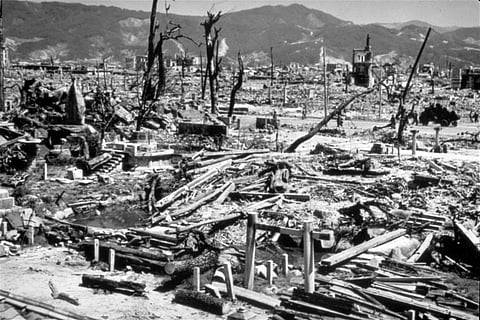
As Tanimoto made his way back toward his neighbourhood in search of his wife, infant daughter and the 120 residents under his care as a local civil defence coordinator, he encountered scenes of overwhelming destruction. Entire streets had been reduced to rubble, while desperate cries of "Help!" echoed from beneath collapsed homes.
Unable to rescue those trapped under the debris on his own, he said he was forced to continue his journey despite the anguish, apologising to the victims as he ran through the ruined city in tears.
The pastor described roads filled with severely wounded survivors who could no longer walk and lay helpless in the streets. Overcome with guilt for remaining physically unharmed, he threw away his hat and silently asked forgiveness, believing his own family might be suffering the same fate.
With fires blocking the usual route home, Tanimoto plunged into the Ota River despite exhaustion and his limited swimming ability. Nearly drowning in the swift current, he prayed that he would survive long enough to rescue his wife, child and neighbours before eventually reaching the opposite bank.
After continuing through the devastated city, Tanimoto unexpectedly found his wife carrying their baby daughter among a line of refugees. Covered in blood, exhausted and shaken, she told him they had been trapped beneath their collapsing home moments after she returned.
According to the memoir, Tanimoto's wife survived only after hearing her infant daughter crying beneath the wreckage. Despite both arms being pinned, she gradually widened a small opening in the debris, pushed the baby through to safety and eventually freed herself before escaping advancing flames.
Although relieved to find his family alive, Tanimoto wrote that he was overwhelmed not with joy but with guilt and indignation, questioning why members of his church had perished while his own family had survived.
The memoir offers one of the most intimate eyewitness accounts of the human suffering caused by the atomic bombing, portraying not only the physical destruction of Hiroshima but also the moral and emotional trauma endured by survivors.