
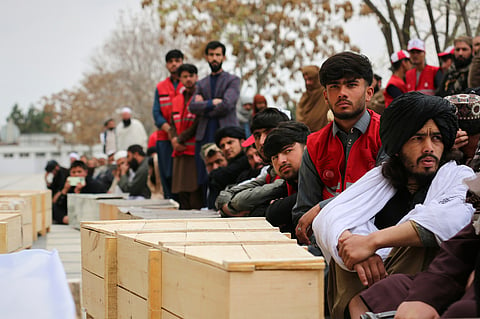
Nearly 500 Afghan civilians killed in cross-border fighting with Pakistan since Oct: UN
Cross-border fighting between Pakistan and Afghanistan has killed 499 civilians and injured 1,216 others in Afghanistan between October and the end of June, the United Nations said on Tuesday.
In a report on the human rights situation in Afghanistan, the United Nations Assistance Mission in Afghanistan (UNAMA) said it had documented 499 civilian deaths and 1,216 injuries resulting from cross-border fighting between the two neighbouring countries, despite international efforts to ease tensions.
The report also highlighted other human rights concerns, including a deadly crackdown on protests in western Afghanistan over restrictions on women's clothing and decrees that effectively legalise child marriage.
Pakistan accuses Afghanistan of harbouring militants
Pakistan and Afghanistan have been engaged in intermittent cross-border fighting for months. Tensions escalated sharply in February after Afghan forces launched a cross-border raid in retaliation for Pakistani airstrikes inside Afghanistan, prompting Islamabad to declare it was in an "open war".
Pakistan accuses Afghanistan of harbouring militants responsible for deadly attacks inside Pakistan, particularly the Tehrik-e-Taliban Pakistan (TTP), which is allied with Afghanistan's ruling Taliban. Kabul has consistently denied the allegations.
According to the report, the deadliest incident occurred in March when a Pakistani airstrike struck a drug rehabilitation centre in Kabul, killing hundreds of civilians. Human rights organisation Amnesty International said last week the bombing should be investigated as a possible war crime.
Pakistan has not released an overall figure for civilian casualties on its side of the border. UNAMA noted that its mandate covers only incidents inside Afghanistan.
Pakistan denies targeting civilians
In a written response to the report, Pakistan's Ministry of Foreign Affairs said Afghanistan's Taliban authorities continue to provide "a permissive environment" for various militant organisations.
The ministry did not address Afghan civilian casualties but said Pakistan's military operations targeted only "identified terrorist hideouts, sanctuaries and support infrastructure" linked to groups responsible for attacks inside Pakistan.
Among the incidents documented by UNAMA were two successive airstrikes on a residential building in Afghanistan's eastern Paktia province on June 28, which killed 22 people, including five children, and injured at least 185 others.
Most of the casualties occurred during the second strike, when local residents were attempting to rescue victims from the first attack.
"International humanitarian law provides special protections for medical personnel and humanitarian workers, including first responders. Attacks against them while performing their duties are strictly prohibited," said Fiona Frazer, Director of Human Rights at UNAMA.
Women continue to face severe restrictions
The report also highlighted the worsening situation for Afghan women under Taliban rule, including bans on education beyond primary school, strict dress code requirements, restrictions on employment and a requirement to be accompanied by a male relative when outside the home.
It detailed a crackdown in the western city of Herat in June, where at least 30 women were arrested for alleged violations of the dress code. At least one person was killed and several others were injured after authorities opened fire during a rare protest against the arrests.
Under Taliban regulations, women must wear a full hijab, including a robe covering the entire body and a face covering that leaves only the eyes visible, when in public. The rules are enforced by the Ministry for the Propagation of Virtue and the Prevention of Vice, although their interpretation varies and is often applied arbitrarily.
UNAMA said officials from the ministry also visited health clinics and shops in different parts of the country, instructing them not to admit women who were not accompanied by a male relative.
The report further said new rules governing marriage arrangements "implicitly sanction child marriage" by allowing marriage contracts to be concluded for minors.