
Burnham vows to fix England's 'broken' social care system
British Prime Minister Andy Burnham on Wednesday pledged to succeed where successive governments have failed by overhauling England's "broken" social care system, which he said relies on an overstretched public sector and profit-driven private providers.
Burnham, 56, described it as a "major dereliction of duty" that politicians had failed for decades to create a social care system that is both affordable for those who need it and sustainable for the state.
"I think social care in England is as unfair as American healthcare," Burnham said. "The vulnerable pay with everything."
The Labour leader said he would seek cross-party backing to establish a National Care Service to complement the taxpayer-funded National Health Service (NHS), which was created after the Second World War to provide free healthcare.
Having become prime minister last week, Burnham said reforming social care was one of his top priorities. Uneven access to care for older people and those living with illness or disability has become an increasingly urgent challenge as Britain's population ages and pressure on public services intensifies.
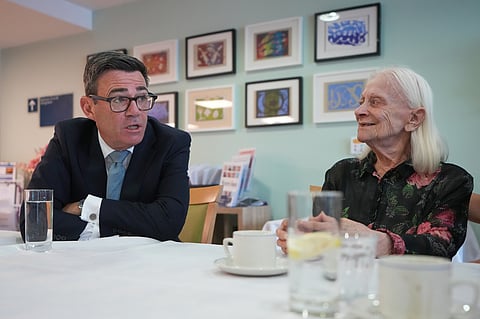
Addressing staff and residents at a London care home, Burnham acknowledged that previous promises of reform had often failed to deliver.
"You've probably got a feeling of déjà vu," he said. "Don't have that. This time we're going to do it."
"It is a major dereliction of public duty that Parliament has not faced up to this, of all challenges," he added, arguing that politicians had "put point-scoring before fixing this issue".
Burnham also acknowledged his own role in past failures, noting that he had proposed reforms in 2009 while serving as health secretary under former Labour Prime Minister Gordon Brown.
After spending a decade as mayor of Greater Manchester before returning to government, Burnham said the issue had become deeply personal as his father is living with Alzheimer's disease.
"I'm making this a test of myself," he said. "I would never forgive myself if I left without having tried."
To drive the reforms, Burnham appointed social welfare expert Louise Casey to lead a nationwide "Big Conversation" aimed at gathering public views on the future of care.
Casey said the initiative would seek to become "a game changer that tries to renegotiate the social contract with the public".
The prime minister also invited opposition leaders to talks on social care, arguing that lasting reform would require political consensus rather than partisan conflict.
The main opposition Conservative Party confirmed its health spokesperson would attend, while Liberal Democrat leader Ed Davey also accepted the invitation. Reform UK, which has seven seats in the 650-member House of Commons despite leading many opinion polls, said it had not been invited.
Burnham acknowledged that meaningful reform could require politically difficult decisions, including possible tax rises.
He also pledged to improve pay, training and professional status for care workers, whom he said perform essential work for "poverty pay".
The government will also review the threshold at which people become eligible for state-funded care, as well as the role of private companies, which operate most of England's care homes.