
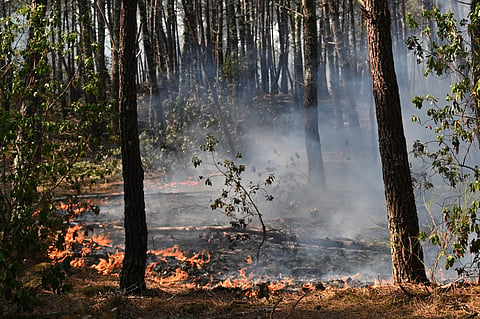
Firefighters battle France's biggest wildfire as extreme heat threatens fresh flare-ups
Firefighters in southwest France battled an uncontained wildfire covering an area four times the size of Paris on Wednesday, as temperatures were forecast to reach 40C, raising fears that a calm night would prove only a brief reprieve.
Authorities in the Gironde region said the blaze had not spread overnight. However, rising temperatures and strengthening afternoon winds could reignite smouldering hotspots, carry embers across firebreaks and spark new fronts beyond firefighters' control.
At the command centre in Lège, crews monitored three high-risk zones: northern Cap-Ferret; the wooded corridor around Marcheprime, Cestas and Saint-Jean-d'Illac; and a military site near Martignas, where a major outbreak prompted a large-scale response.
More than 2,200 firefighters and over 20 aircraft remained deployed, supported by crews from across France and other European countries.
"We strike quickly and strike hard at any new smoke emissions," Gironde fire commander Matthieu Jomain said.
Wednesday forecast to be week's hottest, driest day
The advance of major wildfires in the Landes and Var regions has been halted, leaving Gironde as France's largest remaining wildfire, Interior Minister Laurent Nuñez said.
The Gironde blaze forced about 220,000 people to flee at the height of the crisis. While tens of thousands have since returned home, authorities warned the danger was far from over.
Extreme heat has stripped moisture from vegetation and reduced humidity, turning grass, brush and forest litter into highly combustible fuel.
Météo-France said Wednesday would be the hottest and driest day of the week, with elevated wildfire risks across the country. Drought now affects mainland France and Corsica, with soil moisture approaching the record lows recorded in August 2022.
Smoke from the Gironde and Landes fires also pushed particulate pollution levels higher across both departments, according to regional air-quality monitors.
On Tuesday, authorities ordered another 4,000 people to evacuate tourist sites along the Atlantic coast, expanding what could become France's largest peacetime evacuation.
"The situation remains complicated. That's clear. We're not out of the woods," Gironde prefect Sophie Brocas said, while authorising 60,000 evacuees to return to three Bordeaux suburbs that were spared by the fire.
The contrasting movements — thousands leaving coastal resorts while others returned home carrying emergency bags and keeping mobile phones switched on — underscored the fragile nature of the situation.
The disruption has also begun to affect Bordeaux's peak tourism season.
Edouard le Grix de la Salle, who runs Château du Grand Verdus with his brother, said official appeals urging visitors to avoid the region were hurting wine tourism.
"How did they not think about protecting that sector?" he told The Associated Press.
Tens of thousands return home in Spain
At the height of the crisis, around 330,000 people were evacuated from homes and holiday destinations across France and Spain.
In Spain, tens of thousands of residents began returning home after firefighters made progress in containing wildfires around Madrid and Ávila. Evacuation orders were lifted for about 20,000 people in the Madrid region, while stay-at-home restrictions were eased for another 14,000.
However, around 10,000 people remain under evacuation orders in Castellón, where a wildfire is still burning out of control as Spain braces for its fourth heatwave of the summer.
At one stage, the Gironde wildfire generated a towering pyrocumulonimbus cloud — an electrified thundercloud fuelled by intense heat — producing lightning, violent winds and fresh fires beyond the main blaze. It was the first such phenomenon recorded in France.
More than 1,160 square kilometres have burned across France this year, according to the Interior Ministry.
Europe is the world's fastest-warming continent, heating at more than twice the global average, according to the European Union's Copernicus Climate Change Service. Western Europe experienced its hottest June on record, with extreme heat and prolonged dryness contributing to the spread and intensification of wildfires in France and Spain, the agency said.