
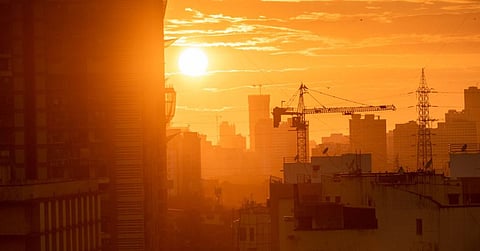
Extreme heat puts South Asia's jobs and growth at risk
Extreme heat is costing South Asia* nearly the equivalent of 31 million full-time jobs every year and is on track to reduce the region's economy by nearly 7 percent by 2050, according to a new World Bank report released today. As South Asia prepares to add 280 million working-age people by 2050, rising temperatures are one of the greatest threats to jobs, productivity, and long-term economic growth in the region.
A livable future
The report warns that by 2070, around 520 million people across South Asia could be exposed to at least one month of dangerous heat each year, four times the current number. It says rising temperatures are already reducing labour productivity, disrupting businesses, straining health systems and critical infrastructure, and disproportionately affecting low-income households, informal workers, women, children, and the elderly.
"South Asia's cities are central to the region's future, but rising temperatures are putting jobs, livelihoods, and economic growth at risk," said Johannes Zutt, the World Bank's vice president for South Asia.
He said making cities more resilient to extreme heat is not only about protecting people but also about safeguarding jobs, improving productivity, attracting investment, and sustaining economic growth.
The report argues that governments should treat extreme heat as a long-term development challenge rather than a seasonal emergency. It recommends investing in heat-resilient infrastructure, strengthening Heat Action Plans, protecting vulnerable workers, expanding sustainable cooling, improving early warning systems, and increasing public and private investment.
John Warburton, climate resilience lead for Asia Pacific at the UK's Foreign, Commonwealth and Development Office (FCDO), described extreme heat as "a development crisis" that is damaging livelihoods, harming public health, reducing productivity, and pushing vulnerable communities deeper into poverty.
The report says measures such as Heat Action Plans, urban greening, resilient infrastructure, early warning systems and energy-efficient cooling have helped reduce the impact of extreme heat in parts of South Asia. However, it says scaling up these efforts will require stronger institutions, better coordination and increased public and private investment.
It warns that as South Asia continues to urbanise, the decisions governments make today will determine whether cities remain engines of jobs and economic growth or become increasingly constrained by rising temperatures.