
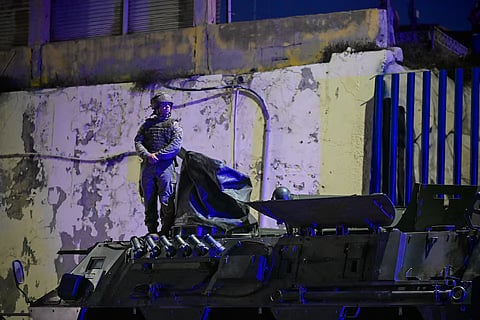
Migrants pour into Spain's Ceuta from Morocco, military called in
Spain on Thursday deployed military units to reinforce police in the Spanish enclave of Ceuta in North Africa as migrants surged by sea and land from Morocco into the territory, and authorities sought to close off another Spanish enclave nearby.
State television TVE reported that 2,000 to 3,000 people had crossed into Ceuta on Thursday. Reuters was not immediately able to confirm that report.
Video footage showed hundreds of migrants swimming or floating on inner tubes from the Moroccan side, and others breaking through a gate on land and running into the city.
In Fnideq, a Moroccan town just beyond the Ceuta border, Moroccan authorities aimed water cannons at migrants very late Thursday in an attempt to deter them from crossing, witnesses told Reuters.
"It was very tough. The police tried to stop us. But our will and determination allowed us to come here," migrant Jadid Zacaria, his hair and shirt still wet from the ocean, said in an interview in Ceuta on Thursday afternoon as migrants streamed through a border gate nearby.
Some of the migrants shouted, "Long live Spain" as they entered the territory.
In Melilla, Spain's second autonomous city in northern Africa, footage from local media and human rights organisations appeared to show clashes at the Beni Ansar border point late Thursday. That has been the only open crossing between Morocco and Melilla for the past six years.
According to Omar Naji of the Moroccan Association for Human Rights, at least three vehicles were set ablaze and injuries were reported among migrants and security forces.
Morocco's Interior Ministry did not respond to requests for comment.
Nine corpses were found in Ceuta on Thursday, local authorities said, adding to a toll of 60 migrants who have died attempting to cross into the enclave in recent months.
The government said 200 specialised police officers and 60 troops arrived from the Spanish mainland to reinforce Ceuta's regular forces. It was unclear whether reinforcements were being sent to Melilla, and authorities were not immediately available for comment.
On a highway 150 kilometres (90 miles) south of Ceuta in Morocco, Reuters witnesses saw groups of young people walking north in hopes of reaching Spanish territory.
The scene was reminiscent of 2021, when some 10,000 people from Morocco and sub-Saharan Africa, many of them minors, entered Ceuta, an enclave of 85,000 people.
Spain's Prime Minister Pedro Sanchez will travel to Ceuta on Friday with Interior Minister Fernando Grande-Marlaska for meetings with security forces and local authorities, his office said.
Shops shut
Many shops in Ceuta were shuttered on Thursday. Enrique Serrano, who runs a women's clothing store, told Reuters business owners were organising self-defence because they believed police resources would be insufficient.
"I'm not opening this afternoon because the situation is extremely tense ... The first thing I have to do is protect my business and my family," he said, adding that hundreds of migrants rushed through the border fence in a matter of minutes during the early hours of Thursday.
Ceuta and Melilla have the European Union's only land borders with Africa. Both cities periodically experience surges in attempted crossings by migrants seeking to reach Europe.
Spain's Socialist government stands out in Europe for its pro-migrant stance, and it has recently launched a programme to provide legal status for some 500,000 undocumented migrants, triggering an influx of applications double that number.
Right-wing parties criticised the drive, arguing it would attract more migrants to Spain, and were quick to blame Sanchez for allowing the situation in Ceuta to reach crisis proportions.
Conservative opposition People's Party leader Alberto Nuñez Feijoo said in a post on X: "The situation in Ceuta is desperate. The government cannot look the other way... because we are facing a national security crisis."
Earlier on Thursday, Ceuta Mayor Juan Jesus Vivas had urged the national government to declare an emergency over the mass arrivals.
Italian Foreign Minister Antonio Tajani said on X that the images from Ceuta showed that Sanchez's migration policy was "misguided."
'An explosion'
Earlier this month, Spain's Supreme Court ruled that migrants intercepted at sea while attempting to reach Ceuta or Melilla cannot be summarily returned under the enclaves' special "border rejection" regime, which allows authorities to immediately send back people caught crossing the border fences.
Spain's government said it was the "exploitation by mafias and criminal organizations" of this ruling that had triggered the migrant surge, not its bid to give legal status to some undocumented migrants.
"It has been a slow trickle since the Supreme Court's ruling, but today has been an explosion," the Guardia Civil spokesperson told Reuters.
The Interior Ministry said it was working closely with Morocco to address the surge in irregular arrivals, having prevented thousands of migrants from illegally entering Ceuta in recent days.
Mauricio Valiente, director of the Spanish Commission for Refugees, which has lawyers working in Ceuta, said the migrants crossing into the enclave were of Moroccan and sub-Saharan origin, including families.