
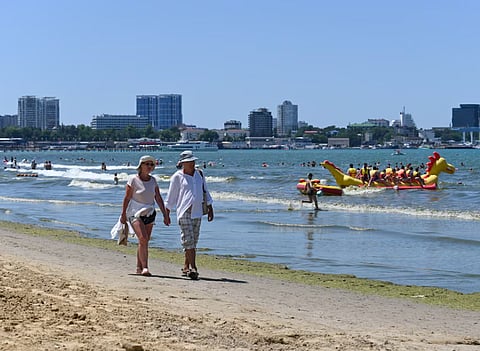
War, fuel shortages cloud Russia's Black Sea holiday season
Russian holidaymakers are flocking to Black Sea beaches this summer, but the country's fifth wartime tourist season is unfolding under the shadow of fuel shortages, drone threats and mounting uncertainty, taking a heavy toll on the travel and hospitality industry.
While children paddle in the warm sea and beaches remain crowded, many tourists say concerns over security have become an unavoidable part of planning their holidays.
The impact has been particularly severe in Russian-annexed Crimea, where around one million holiday bookings had been cancelled by the end of June, according to the Russian Association of Tour Operators (ATOR).
In the resort city of Anapa, businesses that depend on summer tourism are struggling to stay afloat.
Anton Sidorov, owner of the Adrian bistro, said he kept his restaurant closed in May and June because of the lack of customers and had abandoned plans to open for the rest of the season.
"I don't see any point," he said.
Tourists interviewed by Reuters said they now routinely monitor security updates before travelling.
Elmira, who travelled from Moscow with her husband, said they had checked online to ensure there was nothing "alarming" in Anapa before leaving.
"We decided to take the chance. We came here and we have no regrets," she said, adding that they had also familiarised themselves with emergency procedures in case of an air raid alert.
The atmosphere reflects how the war in Ukraine has become increasingly difficult for Russians to ignore, even while on holiday.
During a five-day reporting trip to Russia's Black Sea coast earlier this month, Reuters journalists received missile threat alerts on their mobile phones every day and heard air raid sirens twice. Most beachgoers barely reacted, having grown accustomed to such warnings.
Ukraine says it has intensified drone strikes deep inside Russia in an effort to "bring the war back home", while repeated attacks on oil infrastructure have contributed to fuel shortages across parts of the country.
Tourism sector under pressure
Hotel and restaurant owners say the industry is facing one of its most difficult seasons.
Karina, who owns a hotel in Anapa and declined to give her surname, said she had only 17 guests at a time when she would normally expect between 300 and 350.
"This isn't just a bad season — it's a collapse," she said.
Others have fared better.
Anita Kokourova, manager of the Dream Hotel Anapa, said occupancy was close to full capacity but described the market as highly unpredictable.
"The booking window has shortened, and people are no longer willing to plan ahead because they don't know what tomorrow will bring," she said.
She added that fuel shortages had caused inconvenience but had not halted tourism.
"Fuel is not running out and petrol stations are not closing, so I don't see it as a real problem," she said.
Kokourova said business this summer was stronger than last year, partly because some tourists had chosen Anapa instead of Crimea.
Crimea sees sharp decline in visitors
Crimea, annexed by Russia from Ukraine in 2014, welcomed 7.4 million tourists in 2025. This year, however, the peninsula has experienced widespread fuel and power shortages following attacks that Kyiv says are aimed at weakening Russia's military logistics.
ATOR estimates that cancelled bookings in Crimea had already resulted in losses of up to 25 billion roubles (about $320 million) by the end of June.
The association has urged the Russian government to allow tour operators and hotels to stagger customer refunds until the end of the year, warning that immediate repayments could threaten their survival.
The disruptions have also encouraged more Russians to holiday abroad.
According to ATOR, Turkey accounted for 37.7% of package holiday bookings in July, followed by Egypt with 21.3%, while Russia's share fell to 9.6%, down from 18.4% in the same month last year.
Businesses remain hopeful
Despite the challenges, some tourism operators remain optimistic.
Konstantin, a tour guide in Anapa, said businesses were adapting to the situation.
"Yes, there are problems, just as there are for everyone else, but they can be managed. You just have to plan ahead a little more," he said.
Some tourists, however, admitted they remained uneasy.
"Yes, we're concerned, but we're not hiding anywhere or leaving," said a holidaymaker from Russia's Belgorod region, which has frequently come under cross-border attacks from Ukraine.