
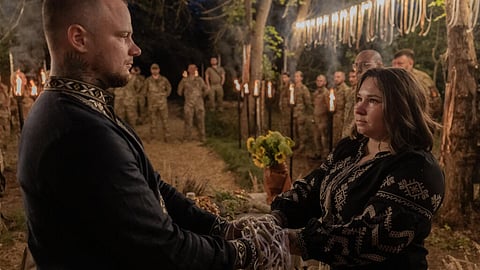
Amid war, Ukrainian soldiers celebrate love at ritual wedding
As twilight settled over a hillside beside a river near Ukraine’s eastern front, two soldiers exchanged wedding vows in a Slavic ritual honouring ancestors and fallen warriors.
Torches lit the way through the woods for the 30-year-old groom, known by his callsign Ice, and his 32-year-old bride, Khomochka, as fellow soldiers formed a guard of honour around them.
“Before our brothers-in-arms and ancestors, before those no longer with us and those who stand before us, we speak this oath,” they said in unison as the ceremony began.
Blending pagan Slavic traditions with Orthodox Christianity, the “Mysteriya” ritual, revived by the Azov brigade, serves as the formal ceremonial framework for the unit’s most significant moments.
Branches were decorated with colourful ribbons and ritual wreaths, while bonfires blazed nearby, ready for the military brotherhood to gather around them.
But the ceremony also drew uninvited guests.
Just before the event began, several long-distance drones — normally used to strike targets in enemy territory — buzzed overhead.
The celebrations went ahead nonetheless.
More than four-and-a-half years into Russia’s invasion of Ukraine, moments of peace and joy have become especially precious to soldiers living with the daily realities of war.
“Events like this show that not everything ends with war — that life goes on,” said Dmytro Rogoziuk, commander of the 60th Brigade.
“To be honest, for me personally as a commander, there are very few events that bring genuine joy.”
‘I swear’
Although the couple had been legally married for a year, they regarded the paperwork as a formality compared with the solemn vows they exchanged before fellow soldiers with whom they had spent a decade fighting and sharing life-and-death risks.
Their daily reality now includes manpower shortages, Russian offensives, limited leave, dangerous rotations to the front lines and news of friends being killed.
The exact death toll from the war remains unknown, although various estimates put military and civilian casualties in the tens or even hundreds of thousands.
Khomochka heads the unit’s medical service, carrying the heavy responsibility of treating and saving wounded soldiers.
“She’s unstoppable, like a live wire,” said Ice, whose blue eyes — the reason for his callsign — warmed as he looked at his wife.
He ended his vows with the words: “Your honour shall become my honour, your home shall become my home.”
Khomochka repeated the words.
Together, they declared before the assembly: “Such is our word, such is our oath. I swear!”
Their friends and brothers-in-arms responded loudly, declaring that they accepted the oath.
“If we don’t live here and now, then when should we live, when we are in a state of war?” Khomochka said.