
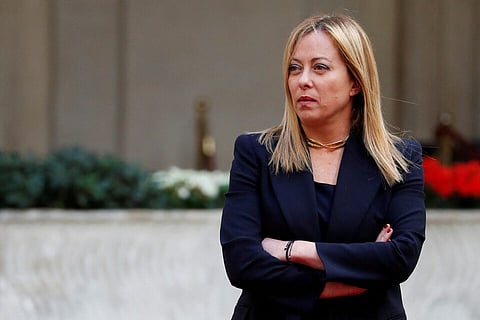
Meloni’s govt becomes Italy’s longest-lasting since World War II
Giorgia Meloni’s hard-right government on Friday becomes the longest-lasting administration in Italy’s postwar history, a milestone that highlights its unusual political stability but also underscores the challenges it faces ahead of next year’s election.
In a country once synonymous with political instability, Italy’s first woman prime minister will have led the same government for 1,413 days — one day longer than the late Silvio Berlusconi managed during one of his four terms in office.
“It is certainly a point of pride,” Marco Osnato, a prominent lawmaker from Meloni’s far-right Brothers of Italy (FdI), told AFP about the milestone.
The record is likely to bolster Meloni’s image as Italy, which has had nearly 70 governments in the past 80 years, prepares for a national election in 2027, analysts say.
With FdI consistently topping opinion polls, Meloni might appear on course to repeat her 2022 victory.
But recent developments have complicated her path to re-election, said Lorenzo Pregliasco of polling institute YouTrend.
Meloni suffered a setback this year when voters rejected a justice reform referendum, a result that showed there “may be an alternative majority” to the coalition currently in power, Pregliasco said.
Success?
The defeat also raised questions about the government’s record.
The reform, which sought to strengthen the powers of the prime minister and increase regional autonomy, was one of three flagship coalition pledges that the government has so far failed to deliver.
Critics say its record has fallen short of expectations in other areas as well. Despite enjoying a comfortable parliamentary majority, the government has failed to address structural problems that many believe are holding Italy back.
“This stability was not capitalised upon,” said Chiara Braga, leader of the centre-left opposition Democratic Party’s parliamentary group.
“It did not lead to any significant improvement in people’s living standards or business competitiveness.”
Italy’s economy is forecast to grow by a lacklustre 0.6 percent in 2026, while real wages have remained virtually stagnant since the early 1990s.
Unemployment has fallen from above 7 percent to around 5 percent over the past four years, but the number of economically inactive people — those who could work but are not seeking employment — remains high.
“This government has primarily sought to survive” by “doing as little as possible”, said Tito Boeri, an economist at Milan’s Bocconi University.
Supporters, however, argue that the government has cut taxes, increased tax revenues and brought greater fiscal discipline to the heavily indebted country. They also credit Meloni with giving Italy a more prominent role on the global stage at a time of heightened geopolitical tensions.
“When it comes to foreign policy, Italy has never been so central, particularly in Europe,” Osnato said, pointing to stricter migration rules and energy policy as areas where Rome is now seen as a driving force in Brussels.
‘Nothing has changed’
Politically, Meloni’s coalition also risks losing voters to Roberto Vannacci, a former general who has regularly criticised migrants and LGBTQ+ people.
His newly formed Futuro Nazionale party is polling at around 7 percent and could emerge as a kingmaker in next year’s election.
Support for the ruling coalition — which includes Matteo Salvini’s far-right League and conservative Forza Italia — is nevertheless being sustained by persistent infighting within the left-leaning opposition and growing voter abstention, analysts say.
Turnout in the 2022 election was about 64 percent, a record low, and fell below 50 percent in the 2024 European elections.
“A sizable share of voters is really disappointed and angry,” said Giovanni Orsina, a political scientist at Rome’s Luiss University.
Italy’s chronic problems have led many people to believe that “no one can solve their problems”, he added.
In August, Meloni was loudly booed at a sporting event in Taranto, a southern city home to a giant steel plant plagued by economic and environmental problems that the government is struggling to keep afloat.
Surveys show that the cost of living, a deteriorating public health system, security and immigration are among Italians’ top concerns.
Those frustrations are evident in Tor Bella Monaca, a working-class eastern suburb of Rome dotted with rundown apartment blocks, cash-for-gold shops and discount stores.
The district, which is governed by Meloni’s party, regularly records some of the lowest voter turnout rates.
“Nothing has changed in Italy over the 45 years I’ve been on this planet and nothing will,” said Maurizio, a sandal-wearing IT worker who gave only his first name.
He said he was tempted to support Vannacci but would not vote next year, lamenting the lack of a long-term vision for the country.
Others were more optimistic.
“People expect to see improvement overnight,” said Annamaria, 67, a local pensioner and supporter of the prime minister who also declined to give her surname.
“It takes time, but things are getting better,” she said, adding that she believed crime — and migrants — had become less visible in recent months.