
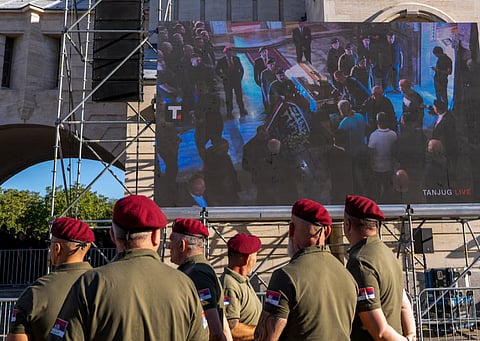
Thousands gather in Belgrade for funeral of convicted war criminal Ratko Mladic
Thousands of people gathered outside a church in Belgrade on Monday to pay their respects to former Bosnian Serb General Ratko Mladic, who died last week while serving a life sentence for genocide, war crimes and crimes against humanity.
Mladic remains a revered figure among many Serbs in Serbia and Bosnia’s autonomous Serb Republic, despite his convictions over his role in the 1995 Srebrenica massacre and the siege of Sarajevo.
People carrying Serbian flags and pictures of Mladic wearing a traditional Serbian military cap arrived outside the church early on Monday to light candles, hours before his scheduled burial.
Free bus services were offered from Bosnia and towns across Serbia for people wishing to pay their respects.
Mladic’s coffin was displayed inside the church, where six men, mainly war veterans from Serbia and Bosnia, took turns guarding it. His wife, son and grandchildren stood inside receiving condolences.
“Time will tell, time is the best judge who will show what kind of person is who and to whom,” said Belgrade resident Jovan Vincic, who had come to the church.
Conflicts triggered by break-up of Yugoslavia
Mladic’s death has stirred strong emotions linked to the break-up of Yugoslavia and the ethnic conflicts that followed across the Balkans.
Mladic was found guilty of genocide by the United Nations International Criminal Tribunal for the former Yugoslavia for his role in the 1995 Srebrenica massacre, in which about 8,000 Bosniak Muslim men and boys were killed after Bosnian Serb forces overran the UN-designated enclave.
He was also convicted over the 43-month siege of Sarajevo, during which about 10,000 people were killed.
Last week, EU enlargement commissioner Marta Kos postponed a visit to Serbia over what she described as the “glorification” of Mladic following his death, including the use of a government plane to return his body to Serbia.
Serbian President Aleksandar Vucic dismissed the comments but did not say whether he would attend Monday’s funeral.
The service was scheduled to be conducted by the patriarch of the Serbian Orthodox Church at noon, after which Mladic was to be buried in a nearby cemetery beside his daughter, who died in 1994.
In Sarajevo, meanwhile, the funeral rekindled painful memories of the war.
“It is really horrible that this is taking place there (in Belgrade) because I know there are normal people who are against it,” said Zdravka Gvozdjar, a retired pharmacist whose nine-year-old son was killed during the Sarajevo siege by a grenade fired by Mladic-led forces. He was among more than 1,000 children killed in the city.
“Mladic ... only deserved to be erased from memory for good, not to be ... promoted as a hero,” she said. “He should be remembered only as a butcher.”