
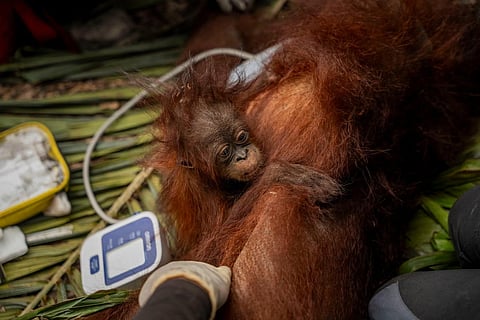
El Niño fires put thousands of orangutans at risk in Indonesia
Indonesia’s worsening wildfires are threatening thousands of orangutans and other endangered wildlife as an unusually strong El Niño brings prolonged dry conditions across the country, The Guardian reports.
The fires have swept through forests and peatlands across Sumatra, Kalimantan and Papua, destroying habitats and producing thick smoke. Primate specialists from the International Union for Conservation of Nature (IUCN) have called for urgent international assistance, warning that thousands of orangutans could be killed, injured or displaced.
According to the IUCN, habitats containing 52% of the world’s Bornean orangutan population are currently affected by the fires.
Wildfires occur annually in Indonesia, where fire is frequently used to clear land for palm oil and pulp plantations. But this year’s severe dryness has allowed fires to spread rapidly, including through peatlands that can continue burning underground.
The impact extends beyond orangutans. Five endangered gibbon species have also been affected, while environmental group Geopix said around 4,500 fires had been detected across 21 Sumatran elephant habitats in recent months.
“I believe that the toll on wild animals being burned, dead, because of the fires is huge,” said Dr Karmele Llano Sanchez, a veterinarian and co-founder of Yiari, a conservation organisation rescuing animals from fire-affected forests.
Yiari has evacuated more than 20 orangutans along with other animals, including pangolins, in cooperation with West Kalimantan’s Natural Resources Conservation Agency. One rescued orangutan died, likely from smoke inhalation, while others suffered burns, dehydration and severe hunger.
“It hasn’t rained in 80 days here, and everything is dried and burned,” Sanchez said. “There are no leaves and no fruits – nothing they can eat.”
Experts warn that the consequences could continue long after the flames disappear. Fires reduce food availability, displace animals and may increase competition and conflict as wildlife is forced into smaller areas. Months of exposure to dense smoke could also have lasting health effects.
Research following Indonesia’s 2015 fires found that orangutans called less frequently in heavy smoke and experienced reduced vocal quality, with some changes persisting for months after the smoke cleared. Gibbons have similarly been observed singing less when exposed to heavy smoke.
Forests can also take years to recover. Researchers say burned areas may produce less fruit afterwards, while tree diversity in peat forests can remain suppressed for more than a decade. Repeated fires could leave some forests permanently degraded.
The fires are also threatening major orangutan research sites. The Tuanan research station in Central Kalimantan and the Rangkong station in West Kalimantan have both been affected in recent weeks. Staff and local residents have been working around the clock to prevent the flames from reaching the facilities.
At Tuanan, researchers have studied around 2,500 trees and individual orangutans for 23 years, creating a valuable long-term scientific record that could be lost if the fire spreads.
Forestry Minister Raja Juli Antoni said the fires could continue until early November as the rainy season is expected to arrive late. Environmental group YKAN estimates that around 600,000 hectares of land were damaged by fires in August.
The IUCN has called for immediate technical and financial assistance, alongside longer-term measures including re-wetting peatlands, tackling deforestation and restoring burned forests rather than converting them into plantations.
Meanwhile, rescuers continue searching fire-hit forests for animals in danger. A mother orangutan and her baby recently rescued by Yiari are being held at a quarantine centre and will be released once a safe forest with sufficient food is identified.