
‘Same ruthless dictator’: UN expert slams Myanmar’s Min Aung Hlaing as conflict death toll exceeds 100,000
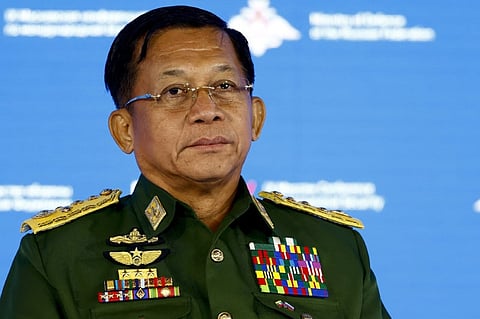
Myanmar’s military ruler Min Aung Hlaing remains a dictator despite assuming the presidency, with the country’s conflict death toll since the 2021 military coup surpassing 100,000, the UN Special Rapporteur on human rights in Myanmar has said.
Addressing the UN General Assembly’s Third Committee in New York on October 27, Kelley Anne Eckels-Currie said the vast majority of those killed in the conflict were civilians.
“Hlaing may have changed his outfit, but he’s still the same ruthless dictator,” she said, according to Mizzima.
The military seized power in February 2021, alleging fraud in the 2020 election, which the National League for Democracy (NLD) won by a landslide. Hlaing later assumed the presidency following military-run elections.
The European Union told the same session that the elections could not legitimise military rule under the guise of a civilian administration.
Currie said the military had intensified its attacks during a 100-day plan announced by Min Aung Hlaing to restore peace and prosperity. The regime had also deployed new coercion and surveillance technologies supplied by its allies China and Russia to suppress dissent, she said.
She cited reports that three humanitarian workers were tortured and killed in Dawei in July for helping local communities. She also warned that regional efforts to normalise relations with the military regime risk prolonging civilian suffering.
However, Currie highlighted local governance initiatives in areas outside military control, including community-led resource management in Karenni State and education and healthcare services for displaced people in Karen State.
Nicholas Koumjian, head of the Independent Investigative Mechanism for Myanmar (IIMM), said the military was increasingly relying on air power, with aircraft, drones and paramotors — powered paragliders — targeting homes, hospitals, places of worship, displacement camps and schools.
He said that two weeks earlier, aircraft had bombed a monastery in Sagaing Region and a church complex in Chin State. A bombing at a market in Rakhine State last month killed more than 50 people, he added.
The mechanism is also investigating a growing number of alleged atrocities committed by armed groups opposing the military.
Koumjian said more than 155,000 Rohingya had fled to Bangladesh since early 2024. The mechanism has collected evidence from more than 1,600 sources and over 750 witness testimonies, up from more than 1,300 sources and 600 testimonies a year earlier.
It has shared evidence with international courts and several countries that have launched preliminary investigations.
UN Secretary-General’s Special Envoy on Myanmar Julie Bishop warned that conditions were not in place for the safe, voluntary and dignified return of Rohingya refugees. She noted that the Arakan Army, an ethnic armed group operating in western Myanmar, now controls 14 of Rakhine State’s 17 townships.
During the ensuing dialogue, Russia’s representative rejected the UN assessments as seriously imbalanced, saying it was “unacceptable to brand Naypyidaw as being to blame” for the crisis. China’s representative cautioned Currie against misleading the public.
Myanmar’s representative to the UN displayed a scarf bearing the names and ages of civilians killed in the conflict.
“The youngest was just two months old. The oldest was 105,” he said, urging countries to stop supplying jet fuel, weapons and money to the military.