
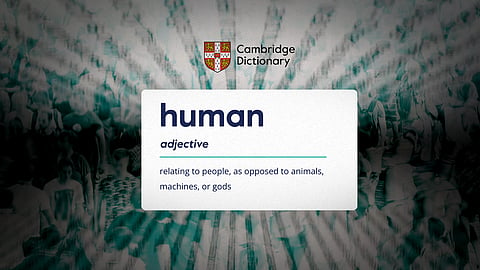
'Human' is Cambridge Dictionary's word of the year
"Human", defined as having the "qualities, faults, and feelings that people have, as opposed to gods, animals, or machines", has been named the Cambridge Dictionary's Word of the Year.
At a time when artificial intelligence (AI) is advancing rapidly, accompanied by dire warnings that it could even wipe out humanity, the word captured "the 2026 zeitgeist", Francesca Woodward, a board member of Cambridge University Press, told AFP.
Over the past 12 months, people have been "really considering what it is to be human", particularly amid concerns that AI could take over their jobs, she said.
"I think people are trying to remind themselves of ... what human means," Woodward added.
The word beat competition from other terms related to AI and the online world, reflecting intense global interest in how technology is reshaping people's lives, she said.
The dictionary's lexicographers have also observed increased use of "human" in compound terms such as "human-made" and "human author", she added.
Tom McClelland, a philosopher of science at the University of Cambridge, described "human" as a "really interesting choice ... because right now our understanding of humanity is changing".
Global AI debate
"We're trying to understand the difference between a human mind and an artificial mind, between living beings like us and artificial beings that we're creating. What sets us apart, is it consciousness, creativity or compassion?" he said.
The debate over what it means to be human has drawn contributions from global leaders and prominent figures, including Pope Leo XIV, Bill Gates, classicist Mary Beard and actor Cate Blanchett.
Other contenders for the Word of the Year included "agent", referring to an artificial intelligence system capable of operating in complex ways without human control.
Also in the running was "wholesome", defined as "good for you, and likely to improve your life either physically, morally, or emotionally".
"Dusking" was another contender, referring to the practice of watching daylight turn to darkness as a form of relaxation. A Dutch tradition, it has been revived as a way of reconnecting with the natural world.
Other new words added to the dictionary in 2026 included "aura farming", meaning doing things to display a personality that others will admire, and "looksmaxing", the practice of making oneself as physically attractive as possible.
The Word of the Year and new dictionary entries are selected based on several criteria, including words searched for on the Cambridge Dictionary website.
Among the words to watch for next year, according to the dictionary, is "FOBO", or "fear of becoming obsolete", referring to concerns about losing one's job to AI.
Another is "weather whiplash", describing a rapid shift from one extreme weather condition to another.
Last year's Word of the Year was "parasocial", describing the feeling of having a connection with a famous person one does not know personally or with a fictional character.