
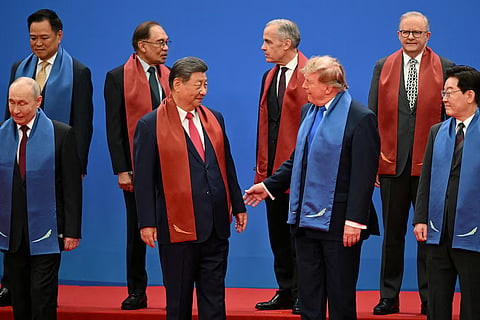
Trump says historic summit with Xi, Putin already a 'win' before event
"They're going hot and heavy on building nuclear weapons. I'd love them not to do it," Trump said of China.
"But when they look at me and they say, ‘OK, we'll do it, but will you reduce your nuclear weapons by 2,000 weapons?’ It's a hard thing to do for me," he said, adding "It's probably hard for them to do also.”
The president has also expressed interest in meeting North Korean leader Kim Jong Un, but there was no confirmation of an imminent encounter. South Korean President Lee Jae Myung said on Thursday he hoped a reopening of dialogue with North Korea would build a lasting peace.
Ahead of the three-way talks, Trump will meet Xi and have a working lunch, while US and Russian officials said he would also meet Putin one-on-one. Moscow officials said no full-scale talks were planned for that meeting.
Trump's Asia trip has offered a chance to showcase US influence, strengthen ties with regional allies and pursue a high-profile diplomatic opening with Xi and Putin.
But the US president will return home facing political and policy challenges, including the fallout from bruising midterm elections, the Nvidia spy scandal and a spate of tech and air travel outages that have rattled Americans.
The leaders have plenty of reasons to appear together but far fewer to agree on substance, given differences over Ukraine, Iran, nuclear weapons, trade and China's military buildup, said Craig Singleton of the Foundation for Defense of Democracies.
"A photograph could serve all three men well," Singleton said, adding that he thought the "agenda is much harder to agree on."
'BEIJING'S WORST NIGHTMARE'
White House officials have said Trump is not expected to raise the issue of the Ukraine war during the meeting, though Trump has suggested he could bring it up. He last met Putin in Alaska in 2025 for talks that failed to end the war.
In the Fox interview, Trump said he would not seek help from Russia and China to bring the Iran conflict to a close.
Trump's talks with Xi will offer a chance to assess the durability of this month's trade truce.
It comes amid growing tension over reports of Nvidia chips being diverted to China through Southeast Asia, raising questions about the effectiveness of US export curbs and the future of Chinese access to advanced technology.
"This is Beijing's worst nightmare. China wants chip access that it can negotiate with the president. It may get chip restrictions written into law by both parties," Singleton said.
US President Donald Trump said his meeting on Thursday with Chinese and Russian counterparts Xi Jinping and Vladimir Putin was already a "win" before it took place, as China gave him a lavish welcome filled with fanfare and pageantry.
The unprecedented diplomatic gathering of the leaders of the world's largest nuclear powers is unlikely to produce major agreements, analysts say, while it unnerves smaller countries that fear their interests might be disregarded.
In an interview with Fox News, Trump highlighted the pomp surrounding his arrival, which contrasted with the more muted greeting of other leaders, including Putin. Japanese Prime Minister Sanae Takaichi landed without any welcoming ceremony.
Xi greeted Trump at the airport, the first time he has done so with any visiting leader since becoming president, reciprocating his counterpart's gesture at Joint Base Andrews in September when they last met. The leaders also briefly hugged.
"This is a great president, one of the great presidents of China, and he's never gone to the airport to meet somebody," Trump said, when asked what he wanted to get out of the trilateral.
"And not only that, the fanfare, the beauty, the pageantry, the thousands of people, the young children, the soldiers, the whole thing. It was great respect, and I appreciate that. That's a big win for us. It's a big win for China too."
Trump arrived after Xi and Putin delivered pointed speeches at an Asia-Pacific Economic Cooperation summit in China's southern tech hub of Shenzhen, denouncing Western trade "protectionism" and sanctions.
During Thursday's APEC proceedings, Xi reiterated his advocacy for what he called "free and open" trade. Western leaders say China's growth model favouring industrial strength over consumers is unfair and creates destabilising global trade imbalances.
Putin, fresh from a setback in his war against Ukraine after the crippling of a key bridge linking Crimea to Russia, said Russia was an integral part of the Asia-Pacific region's food and energy security.
Trump told the audience the US has been a Pacific power for hundreds of years and touted the strength of its economy.
On AI, he said: "It's almost completely good, but it's got some bad elements, and we have to be very careful," adding he opposed regulation that would "stifle" the industry.
Tough nuclear arms discussion
Trump has insisted nuclear arms control be a central topic of the summit, despite China's repeated objections to joining talks with Washington and Moscow, which have far larger nuclear arsenals.
"They're going hot and heavy on building nuclear weapons. I'd love them not to do it," Trump said of China.
"But when they look at me and they say, ‘OK, we'll do it, but will you reduce your nuclear weapons by 2,000 weapons?’ It's a hard thing to do for me," he said, adding "It's probably hard for them to do also.”
The president has also expressed interest in meeting North Korean leader Kim Jong Un, but there was no confirmation of an imminent encounter. South Korean President Lee Jae Myung said on Thursday he hoped a reopening of dialogue with North Korea would build a lasting peace.
Ahead of the three-way talks, Trump will meet Xi and have a working lunch, while US and Russian officials said he would also meet Putin one-on-one. Moscow officials said no full-scale talks were planned for that meeting.
Trump's Asia trip has offered a chance to showcase US influence, strengthen ties with regional allies and pursue a high-profile diplomatic opening with Xi and Putin.
But the US president will return home facing political and policy challenges, including the fallout from bruising midterm elections, the Nvidia spy scandal and a spate of tech and air travel outages that have rattled Americans.
The leaders have plenty of reasons to appear together but far fewer to agree on substance, given differences over Ukraine, Iran, nuclear weapons, trade and China's military buildup, said Craig Singleton of the Foundation for Defense of Democracies.
"A photograph could serve all three men well," Singleton said, adding that he thought the "agenda is much harder to agree on."
'Beijing's worst nightmare'
White House officials have said Trump is not expected to raise the issue of the Ukraine war during the meeting, though Trump has suggested he could bring it up. He last met Putin in Alaska in 2025 for talks that failed to end the war.
In the Fox interview, Trump said he would not seek help from Russia and China to bring the Iran conflict to a close.
Trump's talks with Xi will offer a chance to assess the durability of this month's trade truce.
It comes amid growing tension over reports of Nvidia chips being diverted to China through Southeast Asia, raising questions about the effectiveness of US export curbs and the future of Chinese access to advanced technology.
"This is Beijing's worst nightmare. China wants chip access that it can negotiate with the president. It may get chip restrictions written into law by both parties," Singleton said.