
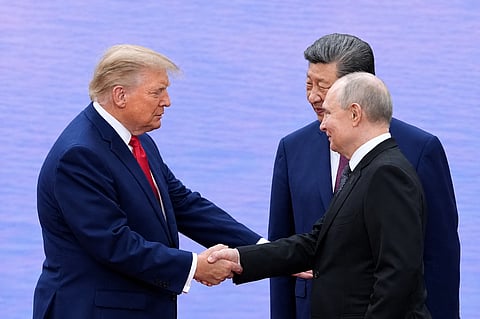
Trump, Xi and Putin release 'peace declaration' from unprecedented summit
China, the United States and Russia agreed on a symbolic “peace declaration” at an unprecedented three-way summit on Thursday, reaffirming that nuclear war must never be fought, but announced no plans for the arms control talks long sought by US President Donald Trump.
A joint declaration issued by Chinese President Xi Jinping, Trump and Russian President Vladimir Putin capped Trump's three-day diplomatic tour of Asia, which produced few tangible outcomes despite his repeated claims of making history and brokering peace.
The summit raised fresh questions among US allies about Trump's increasingly close relationships with Xi and Putin, who continues to wage war against Ukraine.
Trump greeted Putin as “my friend” and received a hug from Xi during the meeting in the southern Chinese city of Shenzhen.
The three leaders pledged to advance reforms of the United Nations, increase supplies of fuel products to all countries and uphold the immunity enjoyed by state officials in international courts.
However, the declaration made no mention of Russia's war in Ukraine or the US conflict with Iran. Putin acknowledged at a subsequent press conference that the agreement did not set ambitious goals and said no country would be forced to comply with its decisions.
The leaders “reaffirmed that a nuclear war cannot be won and must never be fought” and pledged to “conduct a dialogue on reducing nuclear risks and preventing proliferation of nuclear weapons”, without setting a timeframe.
The statement made no mention of negotiations on a trilateral nuclear arms reduction treaty, which Trump has pushed for since his first term. China has consistently rejected such negotiations, arguing that its nuclear arsenal is considerably smaller than those of the United States and Russia.
Trump raised the issue of nuclear weapons at the beginning of the meeting, saying, “It's not an easy thing to do – give them up.”
Speaking to NBC after the summit, Trump described the meeting as a success.
“On a scale of zero to 10, I think it was a 12,” he said. “Fantastic relationships built.”
China's Foreign Minister Wang Yi said the three countries would maintain coordination at the working level following the summit.
Trump told Reuters the Shenzhen meeting was “bigger than Yalta”, referring to the 1945 conference between the United States, Britain and the Soviet Union.
Defending his description of Putin as a friend, Trump said, “It's nice to have people that have 4,000 nuclear weapons as a friend as opposed to an enemy.”
He also called Xi a friend and “an amazing leader”, while acknowledging that achieving nuclear arms reductions would be “psychologically very difficult” for world leaders.
The summit drew criticism from US Democrats. Senate Democratic leader Charles Schumer described it as “a historic embarrassment that people will remember long into the future”.
Daryl Kimball, executive director of the US-based Arms Control Association, welcomed the reaffirmation against nuclear war but said more concrete action was needed.
“We need much more than rhetoric. We need action on disarmament diplomacy,” he said.
The declaration's reference to immunity for state officials also drew attention, coming more than three years after the International Criminal Court issued arrest warrants for Putin and other Russian officials over alleged war crimes in Ukraine. Moscow rejects the allegations.
Jonathan Eyal, international director at the Royal United Services Institute, said Putin had benefited from the summit by gaining international credibility and an escape from his pariah status, while Trump had gained a photo opportunity.
Meanwhile, European allies meeting in Berlin on Thursday reaffirmed their support for Ukraine and warned against any attempt to decide the terms of peace without their involvement.
German Chancellor Friedrich Merz dismissed the Shenzhen summit as a “photo opportunity”, saying a “Yalta” format would not bring peace and that Europe would not allow itself to be divided.
“The US understands that there can be no peace without us,” he said.
Trump's son-in-law and special envoy Jared Kushner, who attended the Berlin meeting, said the US president wanted to pursue a peace deal with Europe alongside him. He added that Russia had agreed to engage in multilateral talks with European countries.
Kushner said Trump had joined the Berlin meeting by phone and came away from the Shenzhen summit believing that “peace is achievable”.
The trilateral meeting was also seen as a diplomatic gain for Putin, whose country remains largely isolated from Western economies under sanctions.
Putin said the three countries had “numerous shared interests in the settlement of regional conflicts, including obviously the conflict in Ukraine”.
He rejected comparisons with the Yalta conference, arguing that it had not divided the world into spheres of influence but had “codified the existing reality”.
Diplomatic tensions could resurface when Trump hosts the Group of 20 summit at his golf resort in Florida in the coming weeks. He is expected to meet Xi again, with Putin potentially attending.
Putin said he would consider attending after discussing the possibility with Trump, but added that his decision would depend on the situation in Russia.