
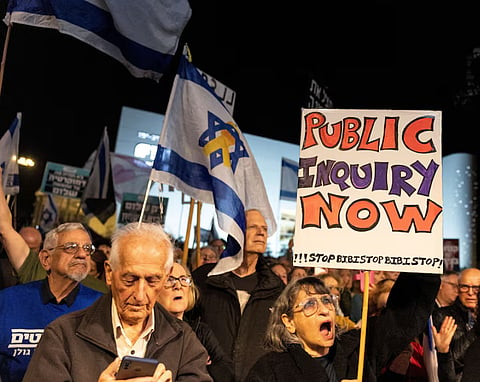
Israeli opposition advances October 7 attack probe opposed by Netanyahu
Israel's parliament on Wednesday gave initial approval to a bill establishing an independent state commission to investigate the country's failures leading up to the October 7, 2023, Hamas attack, a probe opposed by Prime Minister Benjamin Netanyahu.
The vote was the first of four required for the bill to become law.
Parliament also approved a separate bill proposing term limits for prime ministers and barring them from serving while under criminal indictment, measures apparently targeting Netanyahu, who faces corruption charges that he denies.
Netanyahu remains in office in a caretaker capacity after his coalition lost its parliamentary majority in an election last month.
In a televised address, Netanyahu described the proposed restrictions as “a tool for political elimination” used in Iran and several dictatorships. “There's nothing like that in any democracy,” he said.
Opposition parties have taken control of the parliamentary agenda, although opposition figure Gadi Eisenkot, who was tasked by Israel's president with forming a new government, has struggled to secure enough support to replace Netanyahu.
‘We will uncover the truth’
The proposed state commission has broad public support, according to surveys.
“For the bereaved families, for the survivors of captivity and those who did not return to us alive, we will uncover the truth and take every step to prevent the next disaster,” Eisenkot said in a social media post.
Eisenkot's bloc of Jewish-led opposition parties secured support from parties representing Israel's Arab minority to pass the bill. A total of 65 lawmakers voted in favour, while 50 opposed it.
Netanyahu has rejected an independent inquiry, instead calling for a government-appointed investigation panel whose members would be selected by parliament and whose mandate would be determined by the cabinet. Critics, including Eisenkot, say the proposal would allow Netanyahu to cover up the truth.
There was no immediate comment from Netanyahu or his office on the bill. Transport Minister Miri Regev, a close ally of the prime minister, said the legislation would not examine the failures that occurred but would instead “investigate our brave, heroic soldiers”.
Hamas-led militants killed 1,200 people and took more than 250 hostages in the October 7, 2023, attack on southern Israel. The attack triggered Israel's military offensive in Gaza, which has killed more than 74,000 Palestinians and displaced nearly the entire population of 2 million.
Political deadlock
Netanyahu's coalition of far-right and ultra-Orthodox parties lost its parliamentary majority in the October 27 election, securing 53 seats in the 120-member Knesset, although his right-wing Likud party remains the largest.
Eisenkot's bloc, comprising Jewish-led right-wing, left-wing and centrist lawmakers, won 48 seats. Most of those parties have so far refused to form a coalition with Arab-led parties, which secured a record 19 seats.
Eisenkot has until December 6 to form a coalition, with the possibility of a 14-day extension.
Arab lawmakers have so far supported Eisenkot and his allies in parliamentary votes, allowing them to advance legislation and set the assembly's agenda. Last week, they helped elect a member of Eisenkot's Yashar party as Knesset speaker.
If Eisenkot fails to form a government, Netanyahu would likely get another opportunity. If no government can be formed, Israel would hold another election.