
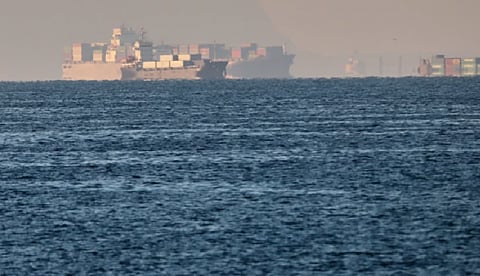
US military attacks merchant ship in Gulf of Oman
The US military attacked a merchant ship in the Gulf of Oman on Thursday, saying the vessel had tried to evade its naval blockade of Iranian ports, according to an Associated Press report carried by UNB.
US Central Command (CENTCOM) said on Friday that a military aircraft fired precision-guided weapons at the stern of the Palau-flagged Pacific Archer, disabling its propulsion system. CENTCOM said none of the civilian crew members were injured.
The US military said the ship had left Iran’s Bandar Abbas port. Maritime tracking platforms listed Singapore as its destination.
Iranian navy commander Shahram Irani said on state television on Friday that Tehran would carry out operations to break the blockade and drive foreign forces out of regional waters.
US blockade disrupts merchant shipping
Washington imposed the blockade in April. It temporarily lifted the restrictions during talks with Tehran before reinstating them in July.
The US military says it has diverted 158 merchant vessels since the blockade resumed. The Pacific Archer is at least the 15th vessel publicly reported to have been disabled by US forces since April and the sixth since July. The previous reported incident was on November 7.
Previous US strikes on commercial vessels have drawn criticism. Indian officials said three Indian sailors were killed when US forces struck the tanker Settebello. The head of the International Maritime Organization condemned the strike.
CENTCOM has said US forces issue several warnings to merchant vessels before taking military action.
Iran reports mine incident in Strait of Hormuz
Iran’s Islamic Revolutionary Guard Corps said on Friday that two oil tankers had tried to pass through the Strait of Hormuz along a route Tehran had not authorised. It said one hit a naval mine and the other was forced to turn back. The claims could not be independently verified.
The Guards said fewer tankers had tried to use routes Tehran considers unauthorised in recent days. Iran has warned commercial ships against passing through the strait without its permission.
Diplomatic efforts to prevent escalation
The attack comes as the Trump administration weighs its next steps in the conflict with Iran, which began in late February and has largely been at a stalemate in recent months.
Regional officials told The Associated Press earlier in November that Israeli Prime Minister Benjamin Netanyahu had urged Washington to resume military operations against Iran or allow Israel to strike Iranian nuclear and missile facilities.
Officials from Gulf countries, Pakistan and Turkey have stepped up talks with senior US officials to avert another escalation. US President Donald Trump has threatened further large-scale strikes while also saying the war is effectively over from a military standpoint. The US maintains two aircraft carriers and several other warships in the region.
Oil shipments fall
Oil flows fell by about 20 percent in the first two weeks of November compared with October, to roughly 13 million barrels a day, according to research firm Rystad Energy. Shipments had recovered to about 15–16 million barrels a day in October, close to pre-war levels.
Iranian attacks have discouraged tanker operators from crossing the Strait of Hormuz. Shipments through a major Saudi pipeline to the Red Sea port of Yanbu have also fallen following attacks on the facility.
The UN Conference on Trade and Development said disruptions in the Strait of Hormuz, the Red Sea, the Black Sea and the Panama Canal have lengthened shipping routes, raised fuel costs and worsened port congestion. Businesses have kept goods moving through alternative ports and inland routes, at higher transport costs.
___