
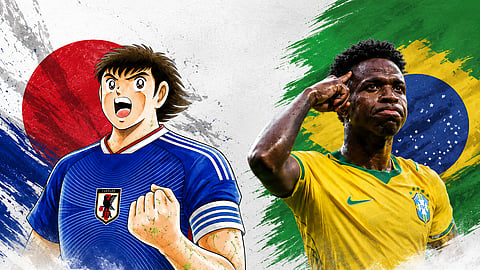
From manga to reality: Japan look to complete the ultimate fantasy against Brazil
The year was 1994. Japan, a team nobody gave a chance, routed Italy 4-0 and defeated the Netherlands 1-0 to reach the final of the World Youth Championship.
Their opponent in the final: Brazil.
The South Americans started as the clear favourites, but Japan soon proved themselves as worthy contenders, with captain Tsubasa Ozora giving them the lead in the first half.
Brazil’s skipper Carlos Santana soon levelled the score as the first half ended 1-1.
Tsubasa once again put Japan ahead in the second half, but in the very last minute of regular time, Brazil’s substitute forward Natureza’s fierce strike from outside the box beat Japan’s goalkeeper Genzo Wakabayashi.
At the final whistle, the score was 2-2.
The match then went into 30 minutes of extra time, with the Golden Goal rule in effect, meaning the next team to score would win the final. Otherwise, the match would be decided through a penalty shootout.
Tsubasa, having already scored a brace, mustered all of his remaining strength to burst into the Brazil box one final time. And then, with an incredible overhead kick that defied physics, he completed his hat-trick as Japan conquered Brazil 3-2 to lift the trophy.
It was truly a match for the ages, a contest too good to be true.
And for good reason, as none of it was real.
This match took place in Yoichi Takahashi’s globally acclaimed Manga series ‘Captain Tsubasa’, which sold over 90 million copies worldwide and has been adapted into anime in multiple languages.
The manga first came out in 1981, 12 years before Japan started its first professional football league and 17 years before they qualified for their maiden World Cup.
And now, 32 years later after Japan’s win over Brazil in the fictitious world of ‘Captain Tsubasa’, Japan are up against Brazil in a knockout fixture for real in the Round of 32 of the FIFA World Cup 2026.
The match, set to take place in Houston, is more than just a knockout fixture for Japan, it’s the ultimate test of how far they have progressed in the sport against the very nation that has guided them through this journey.
It’s an opportunity for Japan, the student, to surpass Brazil, the mentor.

Tracing Japan’s Brazil connection
Even though they seem poles apart, Brazil and Japan actually share a deep connection.
Brazil houses the largest Japanese community outside of Japan in the world, while Brazilians constitute the largest non-Asian population in Japan.
Their connection extends to football as well, as Brazilians have had a profound impact in popularising the beautiful game in the Asian country.
Zico, known as ‘White Pele’, came out of retirement in 1991 to play for Sumitomo Metals in the amateur Japanese league.
He played for the club till 1994, hanging up his boots only after featuring in the inaugural season of the Japan Professional League (J League) for Sumitomo, which was then rebranded as Kashima Antlers.
The Brazilian then coached Japan to the AFC Asian Cup title in 2004 and took them to the World Cup 2006, where ironically, the Samurai Blue’s campaign ended with a 4-1 defeat against Brazil.
That remains the only meeting between the two teams in the World Cup, before their impending face-off in the newly introduced Round of 32.
After Zico, several marquee Brazilian players plied their trade in Japan, including seven members of Brazil’s 1994 World Cup-winning team, which included the likes of Dunga, Careca and Bebeto.
Even now, Brazilians turn up in big numbers in the J. League. Last season, a total of 43 Brazilians played in the league, which amounts to 46 percent of the league’s total overseas players.
The Japanese have been enthralled by the Brazilian football for decades. Many say that their own style of football is a mix of Brazilian short-passing and fluid movements alongside Japanese discipline and precision. A more organised version of Brazil’s ‘Joga Bonito’, if you will.
The Japanese people have been in awe of Brazilian football for decades; they hail Zico as ‘The God of football’ and employ Brazilians in their league at great numbers.
For Japan, Brazil is their mentor in football. And that is exactly why they are so desperate to knock Brazil out of the World Cup.
Student surpasses the mentor
In the manga, Tsubasa’s mentor was a former Brazilian footballer, Roberto Hongo.
He spotted him at a young age, nurtured his talent, helped him get a footing in Brazil’s domestic league and set him on his path to reach his full potential as a player.
In the final of the World Youth Championship, Roberto was present at the ground, but not as a cheerleader for his beloved pupil, but as coach of the Brazil team.
Knowing Tsubasa’s strengths and weaknesses, Roberto laid out a plan to defeat his student. But Tsubasa overcame every challenge and once and for all, surpassed his mentor.
By putting Brazil against Japan, writer Takahashi pulled off the classic ‘student surpasses teacher’ cliché perfectly.
By showing Japan defeating Brazil, he projected a fantasy that seemed out of reach for the Asian side, up until last year.
In their last meeting, in October 2025, Japan came from behind to win 3-2 – their first-ever win over Brazil at the senior level.
This was a testament to Japan’s steady growth as a football nation.
Japan have qualified for every World Cup since 1998, have reached the knockout stage thrice but have never won a knockout fixture.
Facing Brazil in the Round of 32 presents Japan with a chance to overcome that mental block as well as announce themselves as a contender for the trophy.
In the manga, Tsubasa pulled off a miracle for Japan. Now, it's time for the Samurai Blue to make it a reality.